
Quick answer
VA tort claim payouts are settlements or judgments paid by the U.S. Treasury under the Federal Tort Claims Act (FTCA) to veterans harmed by VA or military medical providers. Amounts vary widely by injury severity and representation. Based on 16 years of U.S. Treasury Judgment Fund data (2009–2025), Archuleta Law Firm clients averaged $241,641 per case — nearly four times the $63,219 average for unrepresented claimants (28 U.S.C. § 2678 caps attorney fees at 20% of an administrative settlement and 25% of a court judgment or post-filing settlement).
This page covers what VA tort claims pay. If you need to start one, our guide to how to file a VA tort claim on Standard Form 95 covers the form, where to send it and the deadlines.
How Much Do VA Tort Claims Settle For?
Based on U.S. Treasury Judgment Fund data covering 2009–2025, FTCA medical malpractice settlements range widely by injury severity. The reported averages for two different claimant groups are: Archuleta Law Firm clients average $241,641 versus $63,219 for unrepresented claimants — a nearly 4× difference documented in federal public records.
The amount in an individual case depends on the injury, evidence of liability, documented losses and applicable law. The averages below are historical summaries, not a settlement range or estimate for a new claim.
Under 28 U.S.C. § 2678, attorney fees in FTCA cases are capped at 20% of an administrative settlement — one the agency resolves under § 2672, before any lawsuit — and 25% of a court judgment or of a settlement reached after suit is filed under § 2677. The 20% cap is the one that applies whenever the VA settles a claim at the SF-95 stage. Both are well below the 33–40% contingency fee typical in state court malpractice cases. The filing deadline under 28 U.S.C. § 2401(b) is 2 years after the claim accrues, generally when the injury and its cause were known or reasonably should have been known; missing it almost always bars any recovery.
If you think the 2-year deadline has already passed
The deadline is not automatically fatal. In United States v. Wong, 575 U.S. 402 (2015), the Supreme Court held that the FTCA's § 2401(b) time limits are not jurisdictional and are subject to equitable tolling. Courts grant tolling rarely, and it is not something to plan around — but it means a late claim is a question for a court, not a closed door.
When the clock starts is often the more valuable question. Under United States v. Kubrick, 444 U.S. 111 (1979), an FTCA claim accrues when the claimant knows of the injury and its cause — not when they learn the care was negligent. Veterans who discover a retained instrument, a missed cancer diagnosis, or a misread scan years later frequently have more time than they assume.
How Much Are VA Medical Malpractice Settlements?
Across 16 years of U.S. Treasury Judgment Fund data (2009–2025), Archuleta Law Firm resolved 510 VA medical malpractice cases for $85 million — an average of roughly $166,700 per case. The largest single VA settlement in that analysis is $2.0 million. These figures describe the cases analyzed; they are not a range or an estimate for a new claim.
VA medical malpractice settlements are paid by the U.S. Treasury, not by the hospital or the individual clinician, because the Federal Tort Claims Act substitutes the United States as the defendant for negligent acts of federal employees acting within the scope of employment (28 U.S.C. §§ 1346(b), 2679(b)(1)). Three things move the number in an individual case:
- Severity and permanence of the injury, and the documented cost of future care.
- Economic losses on the record — medical bills and lost earnings are provable; pain and suffering is argued.
- The state standard of care and any state damage cap, because § 1346(b)(1) borrows the law of the place where the negligence occurred. A state cap on non-economic damages binds an FTCA award (28 U.S.C. § 2674), so the same injury can settle for different amounts in different states.
Two federal limits apply to every VA settlement regardless of value: there are no punitive damages (28 U.S.C. § 2674), and attorney fees are capped at 20% of an administrative settlement or 25% after suit is filed (28 U.S.C. § 2678). Prior results do not guarantee a similar outcome.
The Record Behind These Numbers: 600 FTCA Cases Since 2009
Veterans and military families who experience medical malpractice at VA hospitals or military treatment facilities have a choice: pursue their Federal Tort Claims Act (FTCA) claim alone or partner with attorneys who have spent 16 years securing FTCA settlements from the U.S. government.
At Archuleta Law Firm, our track record speaks through the data. Since 2009, we've recovered $145 million for clients through 600 resolved FTCA medical malpractice cases — including a $12.5 million settlement, our largest single FTCA tort claim payout to date.
The Data: Reported Settlement Averages
Filing an FTCA claim against the VA or military healthcare providers is complex. The comparison below describes reported outcomes for different claimant groups; it does not isolate the effect of legal representation.
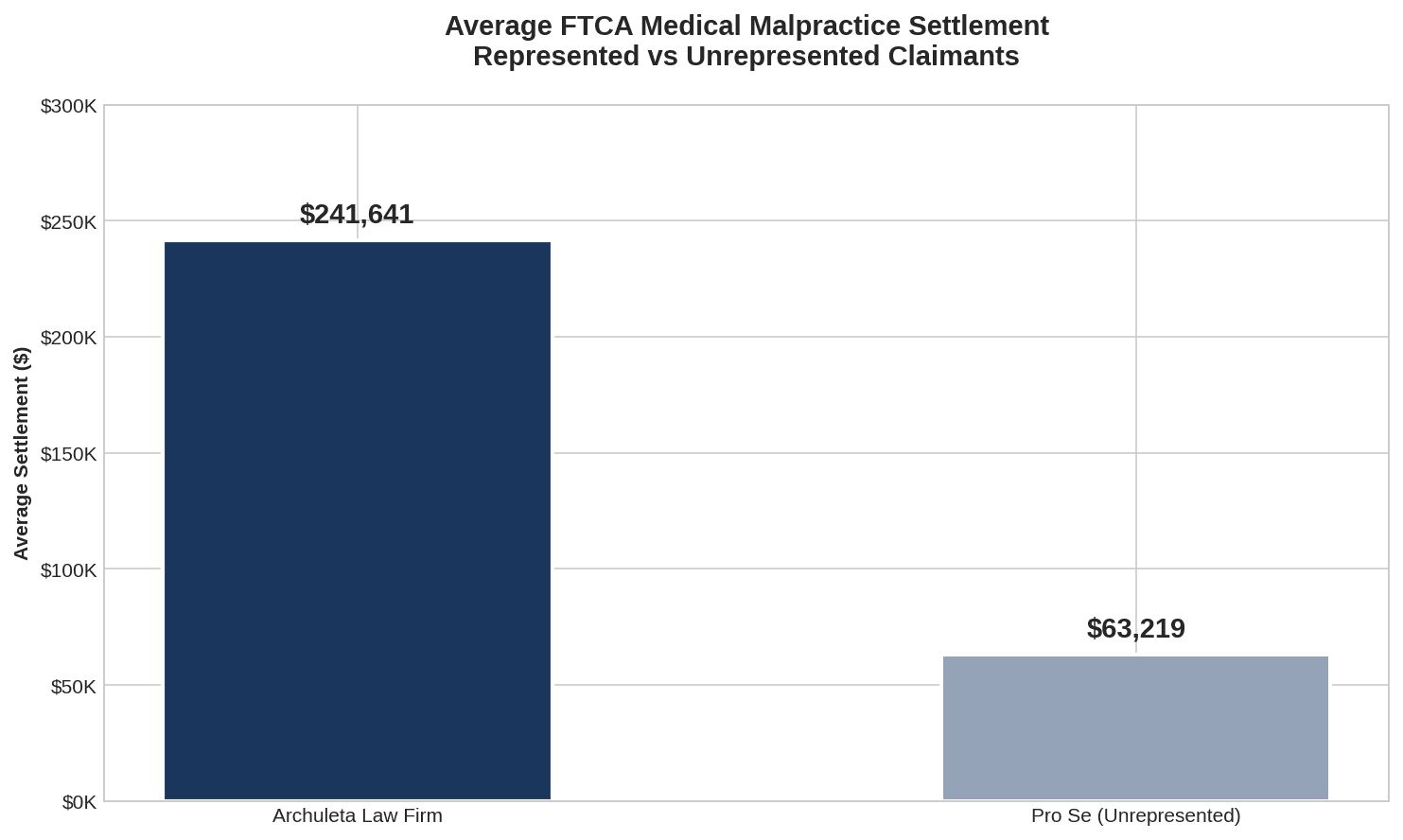
Average FTCA settlement: represented vs. pro se claimants (Treasury Judgment Fund, 2009-2025)
| Representation | Average FTCA Settlement |
|---|---|
| Archuleta Law Firm Clients | $241,641 |
| Pro Se (Unrepresented) | $63,219 |
The reported difference between these averages is $178,422. This is a descriptive comparison, not a controlled estimate of the effect of hiring an attorney. Case severity, case selection and other differences between the groups may affect the averages; past outcomes do not predict a particular claim.
Often, pro se claimants file the Standard Form 95 (SF-95) without understanding the complexities of building a medical malpractice case against the federal government. The SF-95 is just the first step — securing maximum compensation requires skilled navigation of administrative processes, federal procedures, and medical evidence.
Did a VA hospital or doctor harm you?
Our attorneys have handled FTCA cases for injured veterans across the country. The case review is completely free.
Get My Free Case Evaluation →No Fee If No Recovery · Doctor-Attorney on Staff
Our FTCA Results at a Glance
Archuleta Law Firm FTCA case record, 2009-2025
| Metric | Value |
|---|---|
| Total Cases Resolved | 600 |
| Total Recovered for Clients | $145 Million |
| Years of FTCA Experience | 16 consecutive years |
| Largest Single Settlement | $12.5 Million |
| VA Cases Handled | 510 |
| VA Total Recovered | $85 Million |
16 Years of Consistent FTCA Settlement Growth
Our commitment to FTCA medical malpractice claims has grown steadily over 16 years. The Treasury Judgment Fund data shows our trajectory:
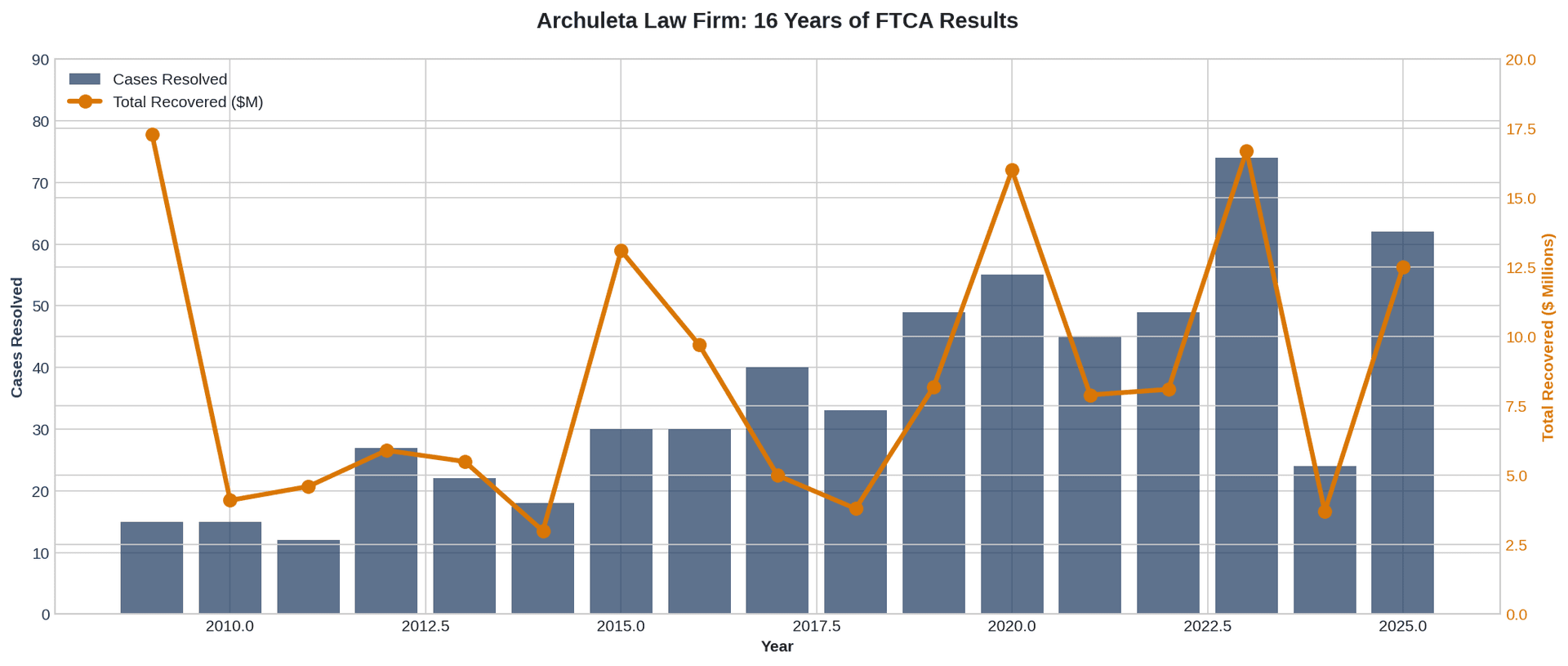
2.8x Growth in Case Volume
Our practice has nearly tripled since we began:
FTCA case volume, first five years vs. most recent five years
| Period | Cases |
|---|---|
| First 5 Years (2009-2013) | 91 |
| Last 5 Years (2021-2025) | 254 |
This 2.8x growth in case volume reflects our expanding capacity to serve veterans and military families nationwide with FTCA tort claims.
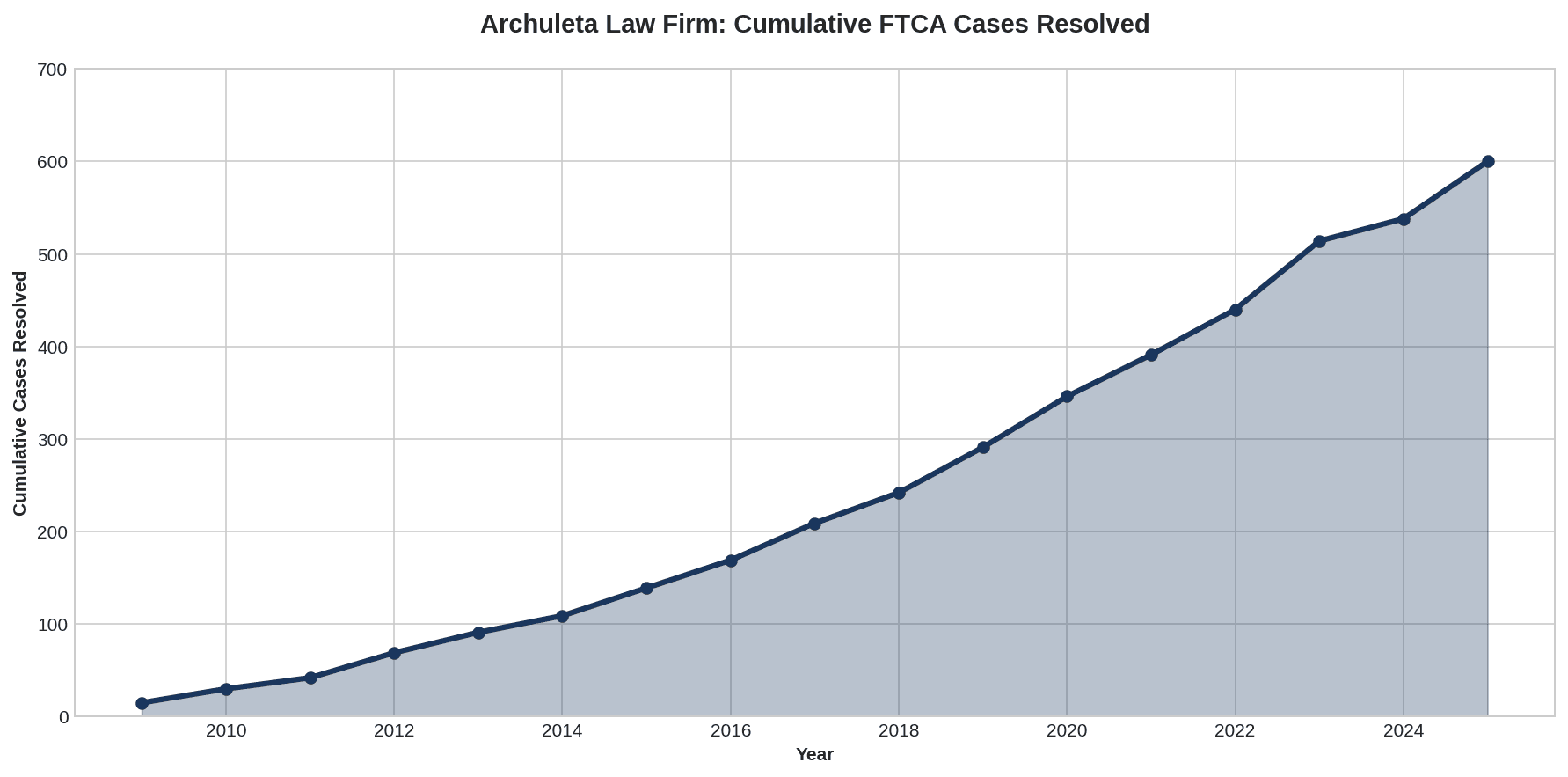
$145 Million Recovered from the Treasury Judgment Fund
Every dollar we've recovered for clients is documented in the U.S. Treasury Judgment Fund — the same database Congress uses to oversee federal tort claim payments.
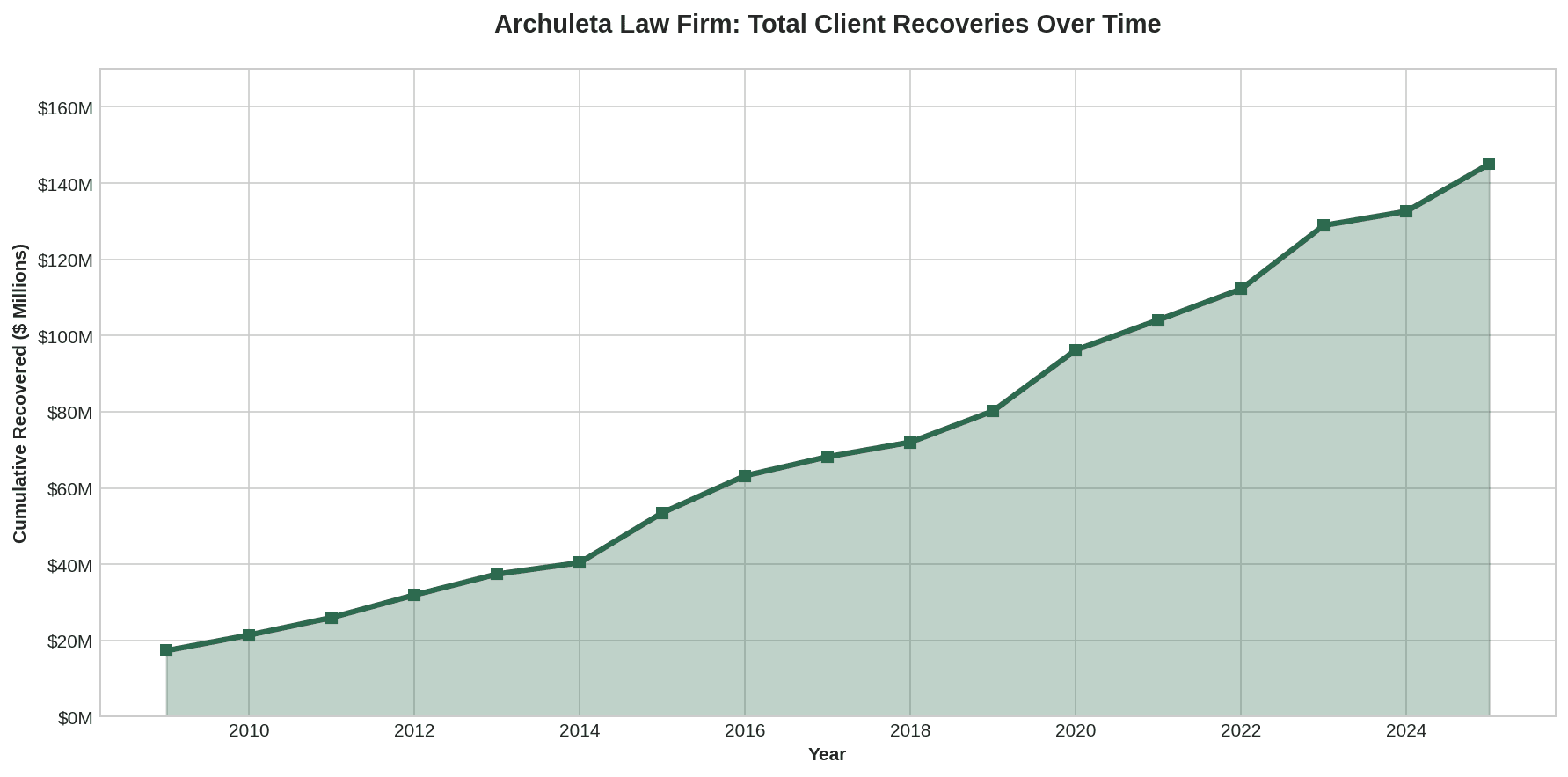
VA Medical Malpractice: 510 Cases, $85 Million Recovered
The Department of Veterans Affairs is where we've focused 85% of our FTCA practice. Veterans deserve experienced representation when suing the VA for medical malpractice. Here's what VA medical malpractice settlements have looked like across our practice:
FTCA cases and recoveries by federal agency
| Agency | Cases | Total Recovered |
|---|---|---|
| Department of Veterans Affairs | 510 | $85 Million |
| Department of Navy | 20 | $24 Million |
| Department of the Army | 55 | $19.5 Million |
| Department of the Air Force | 14 | $15 Million |
Our VA experience means we understand the unique challenges of proving medical malpractice within the VA healthcare system — from documentation issues to institutional resistance.
Top 10 Largest FTCA Settlements
Our case results include some of the largest FTCA medical malpractice settlements in the Treasury Judgment Fund:
Why Choose Archuleta Law Firm for Your FTCA Claim?
Proven Results
VA Focus
Large Case Experience
Nationwide Representation
The Legal Framework Behind Federal Tort Claims Act Settlements
A Federal Tort Claims Act settlement is a monetary payment the U.S. government agrees to pay — without admitting liability in court — to resolve a claim that a federal employee or agency (including VA and military medical staff) caused injury through negligence. The FTCA, 28 U.S.C. §§ 1346(b), 2671–2680, waives the government's sovereign immunity for these claims, and the DOJ Civil Division's Federal Tort Claims Act Litigation Section defends the government and coordinates settlement authority across every federal agency, including the VA and Department of Defense.
Two primary-source references worth reading directly if you want the underlying law rather than our analysis of it:
- Congressional Research Service, "The Federal Tort Claims Act (FTCA): A Legal Overview" — Congress's own nonpartisan legal primer on FTCA scope, exceptions (including the Feres doctrine), and the claims process.
- U.S. Department of Justice, Federal Tort Claims Act Litigation Section — the DOJ division that actually litigates and settles these claims on behalf of the government.
Settlement authority and dollar thresholds vary by agency and case value, which is one reason settlement amounts and timelines differ so widely. The reported outcomes on this page are not a schedule of compensation or a prediction for a new claim.
How Long Does an FTCA Medical Malpractice Settlement Take?
FTCA cases follow a mandatory two-step federal process before any trial can occur. After you file a Standard Form 95 (SF-95), six months must pass before the claimant may treat an unanswered claim as denied under 28 U.S.C. § 2675(a). Most cases with strong medical evidence resolve during this administrative phase.
How long each phase of an FTCA claim typically takes
| FTCA Case Phase | Typical Timeline |
|---|---|
| SF-95 administrative claim review (statutory period) | 6 months |
| Agency negotiation and settlement after response | 6–12 additional months |
| Federal district court litigation (if not settled) | 1–3 additional years |
| Total for typical represented administrative settlement | 12–18 months |
Cases that reach federal trial typically take 2–4 years from SF-95 filing to judgment. Acting promptly matters: the 2-year SOL under § 2401(b) runs from when you discovered — or should have discovered — the injury. Contact us immediately if you are within that window.
How Long Does the VA Have to Respond to a Tort Claim?
The VA has no deadline to respond. The six-month figure is widely misdescribed as an agency deadline; what 28 U.S.C. § 2675(a) actually creates is an option belonging to the claimant. In the statute's words, "[t]he failure of an agency to make final disposition of a claim within six months after it is filed shall, at the option of the claimant any time thereafter, be deemed a final denial of the claim."
The practical consequence: if the VA goes silent past six months, nothing happens automatically. The claim stays open until either the agency issues a written denial or the claimant elects to treat the silence as one and file suit. Waiting past six months is often the right call while negotiations are moving — but because the option belongs to the claimant and no clock forces the agency's hand, a claim can also sit for years if nobody exercises it.
One trap worth knowing: under 38 C.F.R. § 14.604(c), VA's own FTCA regulation, amending a pending claim gives the Department a fresh six months, and "the claimant's option under 28 U.S.C. 2675(a) shall not accrue until 6 months after the filing of the amendment." Raising the dollar figure on a pending SF-95 therefore postpones the right to sue.
What Are the Hardest VA Tort Claims to Win?
The hardest FTCA claims are usually not the ones with the worst injuries. They are the ones the statute itself carves out, or where the evidence cannot connect the harm to the care. Six barriers account for most claims that fail before damages are ever discussed:
Common legal barriers to FTCA claims against the VA and military, with governing authority
| Barrier | What It Does | Authority |
|---|---|---|
| Feres doctrine | Bars a service member from suing for injuries incident to service, including care at a military hospital while on active duty. It does not bar a veteran suing over VA care received after separation. | Feres v. United States, 340 U.S. 135 (1950) |
| Discretionary function exception | Excludes claims based on the exercise or failure to exercise a discretionary function or duty, whether or not the discretion is abused. Policy-level judgments are immune; bedside clinical negligence generally is not. | 28 U.S.C. § 2680(a) |
| Intentional tort exception | Excludes assault, battery, false imprisonment, misrepresentation, deceit and similar claims, except for acts of federal investigative or law enforcement officers. | 28 U.S.C. § 2680(h) |
| Missed 2-year deadline | A claim not presented to the agency within two years of accrual is time-barred, though the limit is not jurisdictional and can be equitably tolled. | 28 U.S.C. § 2401(b); United States v. Wong, 575 U.S. 402 (2015) |
| The sum certain on the SF-95 | Suit cannot be brought for more than the dollar amount stated on the administrative claim, absent newly discovered evidence or proof of intervening facts. | 28 U.S.C. § 2675(b) |
| State standard of care | Federal liability is measured by the law of the place where the act or omission occurred, so state expert-affidavit rules, certificates of merit and damage caps apply to a federal claim. | 28 U.S.C. § 1346(b)(1) |
Note the two that surprise people most. Feres is frequently cited to veterans as though it closed the door on all military medical malpractice — it does not; it turns on whether the injury was incident to active-duty service, and post-separation VA care sits outside it. And the sum certain under § 2675(b) is a one-way door: a figure written on the SF-95 before the full extent of an injury is known can cap the recovery permanently.
Frequently Asked Questions
What is the average FTCA medical malpractice settlement?
Based on 16 years of Treasury Judgment Fund data, the average FTCA medical malpractice settlement differs across the reported claimant groups:
- Archuleta Law Firm clients: $241,641 average
- Pro Se (unrepresented): $63,219 average
These averages describe different claimant groups. They do not establish that representation caused the difference or predict the outcome of an individual case.
How many FTCA cases has Archuleta Law Firm handled?
We have resolved 600 FTCA medical malpractice cases over 16 consecutive years (2009-2025), recovering $145 million for our clients from the Treasury Judgment Fund.
What is the largest FTCA medical malpractice settlement?
Our largest single FTCA settlement is $12.5 million for a Navy medical malpractice case in 2009.
How does Archuleta Law Firm handle VA medical malpractice cases?
VA medical malpractice represents 85% of our FTCA practice. We've handled 510 cases against the Department of Veterans Affairs, recovering $85 million for veterans and their families. Our experience with VA procedures, documentation requirements, and institutional challenges gives us extensive experience in suing the VA for medical malpractice.
What are typical VA medical malpractice settlements?
Per 16 years of U.S. Treasury Judgment Fund data, Archuleta Law Firm has recovered $85 million across 510 VA medical malpractice cases — an average of roughly $166,700 per case. Individual VA medical malpractice settlements depend on the evidence, losses and applicable law; our largest single VA settlement reported in this analysis is $2.0 million.
Why is professional legal representation important for FTCA claims?
FTCA claims are complex federal cases requiring:
- Medical knowledge to prove malpractice against government healthcare providers
- Procedural knowledge of SF-95 requirements and administrative deadlines
- Negotiation experience with federal agencies and the Department of Justice
- Trial capability for cases that require litigation
The reported averages are $241,641 for ALF clients and $63,219 for pro se claimants. These figures do not control for differences in case severity or selection and do not establish what caused the difference.
How has Archuleta Law Firm's FTCA practice grown?
Our practice has experienced 2.8x growth in case volume:
- First 5 years (2009-2013): 91 cases
- Last 5 years (2021-2025): 254 cases
What types of military medical malpractice does Archuleta Law Firm handle?
We handle FTCA claims against all military healthcare agencies:
- Department of Veterans Affairs: 510 cases, $85 million
- Department of the Army: 55 cases, $19.5 million
- Department of the Navy: 20 cases, $24 million
- Department of the Air Force: 14 cases, $15 million
How are tort damages calculated in FTCA cases?
FTCA tort damages include economic losses (medical expenses, lost earnings, future care costs) and non-economic damages (pain and suffering, loss of enjoyment of life). Damages are calculated based on the specific circumstances of each case, the severity of injury, and the long-term impact on the victim's life.
How do I start an FTCA claim for VA or military medical malpractice?
The first step is filing a Standard Form 95 (SF-95) with the appropriate federal agency. However, we recommend contacting us for a free case evaluation before filing — the SF-95 submission sets important deadlines and establishes the framework for your claim.
How long does an FTCA medical malpractice settlement take?
After filing a Standard Form 95 (SF-95), six months must pass before the claimant may treat an unanswered claim as denied under 28 U.S.C. § 2675(a) — the agency itself has no response deadline. Cases with strong evidence typically resolve in the administrative phase within 12–18 months. Cases requiring federal district court litigation take 2–4 years. The 2-year filing deadline under 28 U.S.C. § 2401(b) runs from the date of injury discovery — missing it almost always bars recovery.
What determines how much I receive in an FTCA settlement?
FTCA settlement amounts depend on: (1) severity and permanence of injury; (2) documented economic losses including medical bills, lost wages, and future care costs; (3) non-economic damages such as pain, suffering, and loss of enjoyment of life; and (4) quality of legal representation. Per Treasury Judgment Fund data, Archuleta Law Firm clients average $241,641 versus $63,219 for unrepresented claimants. Attorney fees are capped by 28 U.S.C. § 2678 at 20% of an administrative settlement (§ 2672) and 25% of a court judgment or a settlement reached after suit is filed (§ 2677).
What is a Federal Tort Claims Act settlement?
A Federal Tort Claims Act settlement is a monetary payment the U.S. government agrees to pay — without admitting liability in court — to resolve a claim that a federal employee or agency (including VA or military medical staff) caused injury through negligence. The FTCA, 28 U.S.C. §§ 1346(b), 2671-2680, waives the government's sovereign immunity for these claims, and the DOJ Civil Division's Federal Tort Claims Act Litigation Section defends and settles them on the government's behalf. Per 16 years of U.S. Treasury Judgment Fund data, our FTCA medical malpractice settlements have ranged from roughly $10,000 for minor injuries to $12.5 million for a catastrophic case.
How long does the VA have to respond to a tort claim?
The VA has no deadline to respond. 28 U.S.C. § 2675(a) creates an option for the claimant, not a duty for the agency: the failure of an agency to make final disposition of a claim within six months "shall, at the option of the claimant any time thereafter, be deemed a final denial of the claim." After six months you may treat silence as a denial and file suit; until you do, the claim simply stays open. Under 38 C.F.R. § 14.604(c), amending a pending claim gives VA a fresh six months and postpones that option accordingly.
What are the hardest VA tort claims to win?
The hardest FTCA claims are generally the ones the statute excludes or that run into a procedural bar, rather than the ones with the most serious injuries. The main barriers are the Feres doctrine for injuries incident to active-duty service (Feres v. United States, 340 U.S. 135 (1950)), the discretionary function exception (28 U.S.C. § 2680(a)), the intentional tort exception (§ 2680(h)), the 2-year presentment deadline (§ 2401(b)), the sum-certain cap on the SF-95 (§ 2675(b)), and the state standard of care that federal law borrows under § 1346(b)(1). Feres is the most commonly misapplied: it does not bar a veteran's claim over VA care received after separation from service.
Data Source & Methodology
All statistics presented in this analysis are derived from the U.S. Department of the Treasury Judgment Fund — a source of payments for eligible judgments, settlements and administrative awards against the United States. Treasury explains that the Judgment Fund is unavailable when another source of funds is legally available, so it is not a complete record of every government payment.
Source and methodology for this analysis
| Data Attribute | Value |
|---|---|
| Data Publisher | U.S. Department of the Treasury, Bureau of the Fiscal Service |
| Analysis Period | 2009 – 2025 |
| Data Type | FTCA Medical Malpractice Payments |
This data is publicly available and independently verifiable. Every settlement we reference has been paid through the Treasury Judgment Fund and documented in Congressional reports. For the underlying statute and litigation process itself (rather than our settlement analysis), see the Congressional Research Service's FTCA legal overview and the DOJ Civil Division's Federal Tort Claims Act Litigation Section.
Ready to discuss your FTCA or VA medical malpractice claim? Contact us today for your free case evaluation and let our 16 years of experience work for you.
Injured at a VA hospital?
We've recovered $145 million for veterans and military families. Our doctor-attorney team will review your case for free — no fee unless we recover for you.
Get My Free Case Evaluation →No Fee If No Recovery · Doctor-Attorney on Staff
Related Articles
- Can You Sue the Government? → — Complete guide to suing the U.S. Government under the FTCA
- Standard Form 95 Guide → — How to file your federal tort claim
- FTCA Statute of Limitations → — Critical deadlines for your FTCA claim
- FTCA Claim Dos and Don'ts → — Essential guidance before filing
- Building a Team of Experts → — How expert witnesses strengthen your case
- Veterans Medical Malpractice & FTCA → — VA malpractice claims guide
- Case Results → — $145M+ recovered for veterans and their families